Stablecoin Payments in Hong Kong: Cross-Border FX Settlement and On-Ramp Infrastructure
May 18, 2026
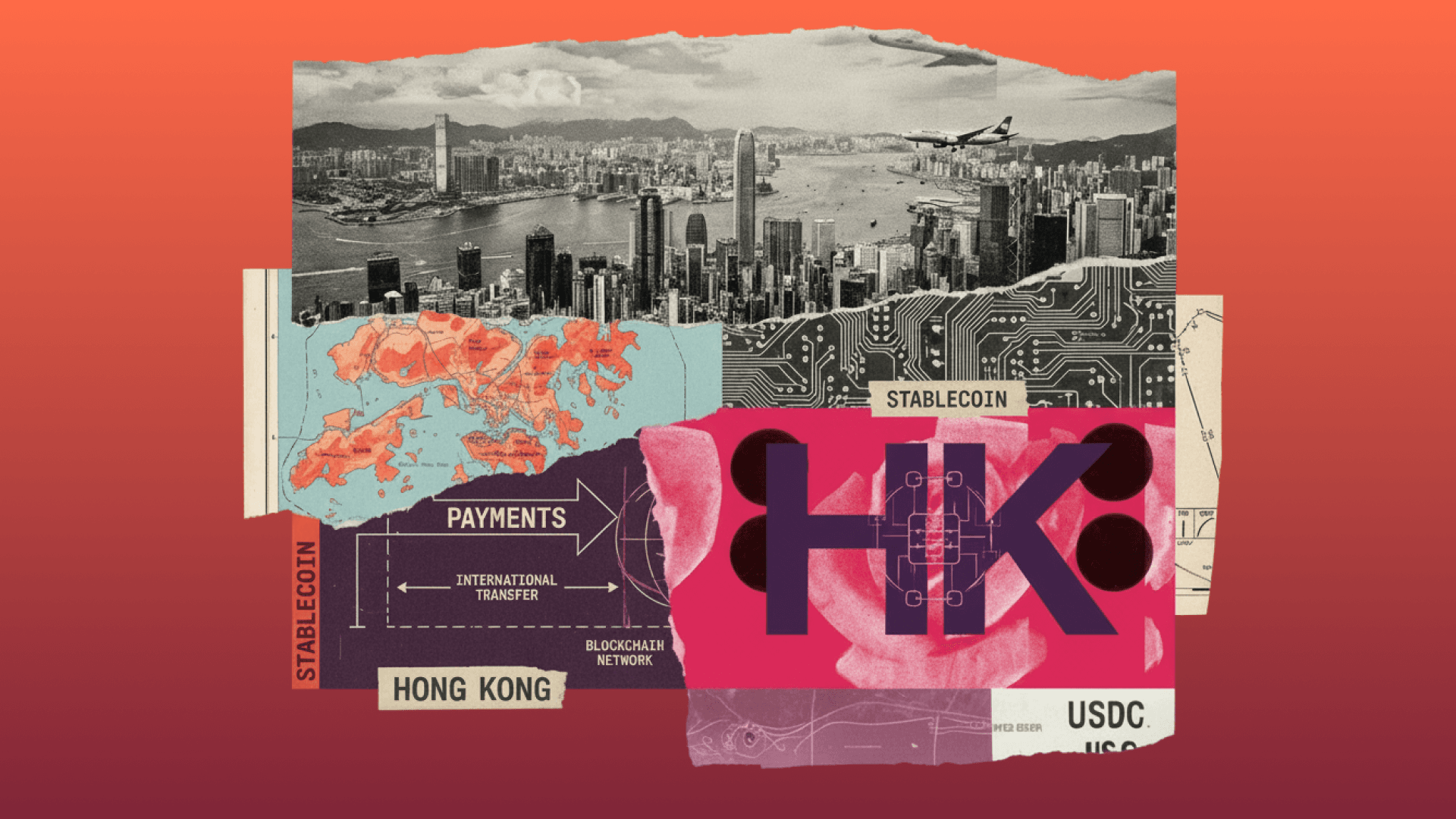
Hong Kong is the world's fourth-largest foreign exchange centre, processing $883.1 billion in average daily FX turnover as of April 2025, a 27.2% increase from 2022. It is also the largest offshore renminbi hub on the planet, with RMB FX turnover reaching $315.1 billion per day. Together with London, New York, and Singapore, Hong Kong accounts for 75% of all global FX trading.
This concentration of FX activity exists because Hong Kong sits at the intersection of several massive capital flows. It is the primary gateway between mainland China and global markets, with 59.1% of its exports destined for the mainland. It hosts regional treasuries for multinationals, commodity trading desks, and the second-largest pool of private equity capital in Asia-Pacific (over $233.9 billion under management). Its payments market is projected to reach $213.93 billion by 2031.
And yet, for all this sophistication, a significant portion of cross-border payment activity in and out of Hong Kong still runs on correspondent banking rails that settle in one to five business days, charge opaque FX spreads, and shut down on weekends. For the PSPs, fintechs, neobanks, and on/off-ramp providers operating in this market, the gap between Hong Kong's domestic payment infrastructure and its cross-border reality represents both a problem and an opportunity.
Stablecoin-powered FX settlement is closing that gap, and Hong Kong's regulators are actively building the framework to support it.
Hong Kong's Domestic Infrastructure Is World-Class. Its Cross-Border Rails Are Not.
Domestically, Hong Kong's payment infrastructure is among the most advanced in Asia. The Faster Payment System (FPS), launched by the HKMA, enables real-time interbank transfers in both HKD and RMB, 24/7. Octopus, the city's contactless payment system, is accepted at over 190,000 touchpoints. Eight licensed virtual banks now compete with incumbents like HSBC and Bank of China (Hong Kong), and digital wallets including Alipay+ and WeChat Pay are widely used by both residents and the millions of mainland tourists who visit annually.
Cross-border is a different story. Payments flowing between Hong Kong and its trading partners (mainland China, ASEAN, the US, the EU) still largely depend on the correspondent banking network. For large institutions with direct banking relationships, this works tolerably well. For mid-market companies, fintechs, and PSPs, the experience is defined by slow settlement, high fees, and limited visibility into where funds are at any given moment.
This friction is compounded by Hong Kong's role as a re-export hub. The city runs on trade: merchandise trade equals roughly 322% of GDP (using Singapore-comparable metrics for entrepot economies). Businesses routinely manage multi-currency flows across HKD, USD, RMB, EUR, and a range of Asian currencies. Each conversion and each cross-border hop through correspondent banking adds cost and delay.
The HKMA recognises this. Initiatives like Project mBridge (a multi-CBDC platform developed with the BIS, Bank of Thailand, and others) and cross-border FPS linkages with Thailand's PromptPay are designed to address the problem. But these projects remain in pilot or early deployment stages. For payment companies that need cross-border settlement infrastructure today, stablecoins offer a more immediately deployable solution.
How Stablecoin Settlement Works in a Hong Kong Context
For a PSP or fintech operating in Hong Kong, stablecoin-powered cross-border settlement follows a straightforward pattern. A client pays in HKD (or USD, given Hong Kong's dollar peg). The payment is converted to a stablecoin (USDC or USDT) via a fiat on-ramp. The stablecoin is transferred to the destination, where it is converted back to local currency via an off-ramp connected to domestic payment rails. Settlement completes in minutes rather than days. The end user on neither side interacts with cryptocurrency.
This model is particularly well-suited to Hong Kong for several reasons.
First, the HKD-USD peg. Because the Hong Kong dollar is pegged to the US dollar within a narrow band (7.75 to 7.85), converting HKD to USD-denominated stablecoins introduces minimal FX risk on the first leg. This makes Hong Kong one of the cleanest entry points into stablecoin-powered cross-border flows anywhere in Asia.
Second, the RMB corridor. Hong Kong processes more offshore renminbi FX volume than any other market. For businesses that need to move value between Hong Kong and mainland China (or between mainland China and the rest of the world via Hong Kong), stablecoin infrastructure offers a way to compress settlement times on the non-RMB legs of multi-currency transactions, while integrating with existing RMB clearing channels for the China-facing leg.
Third, the concentration of regional treasury operations. Multinationals and trading firms that manage Asia-Pacific treasury from Hong Kong are increasingly looking for ways to move liquidity across jurisdictions outside of banking hours. Stablecoin settlement operates 24/7/365, which means treasury teams can rebalance positions, fund subsidiaries, and settle supplier payments on weekends, holidays, and across time zones without waiting for banking cut-off windows.
Codex FX is built for exactly this use case: providing wholesale FX liquidity across fiat and stablecoin pairs, with programmatic execution and settlement that completes in minutes. For payment companies operating out of Hong Kong and settling into emerging markets across Asia, Africa, and Latin America, Codex FX provides the liquidity layer that makes stablecoin-powered cross-border flows practical.
The Regulatory Picture: Clear and Getting Clearer
Hong Kong has moved faster than most jurisdictions to create a dedicated regulatory framework for stablecoins. The Stablecoins Ordinance, passed in May 2025 and effective from 1 August 2025, establishes a licensing regime administered by the HKMA for issuers of fiat-referenced stablecoins (FRS).
The key requirements for licensed issuers include: maintaining 100% reserve backing with high-quality, liquid assets at all times; segregating reserves from the issuer's own funds; guaranteeing redemption at par value within one business day; maintaining minimum paid-up capital of HK$25 million; and meeting ongoing AML/CFT, governance, and disclosure obligations.
The first batch of stablecoin issuer licences is expected to be granted in early-to-mid 2026, with HKMA Chief Executive Eddie Yue indicating that a "very small number" of licences will be issued in the initial wave. Applicants include major firms like Ant Group, signalling serious institutional interest in the Hong Kong market.
For PSPs and fintechs that use stablecoins for settlement (rather than issuing them), the framework provides clarity without imposing direct licensing obligations. Stablecoins issued by HKMA-licensed issuers can be offered through "permitted offerors," including SFC-regulated virtual asset trading platforms, banks, and stored value facility licensees. This creates a regulated distribution channel that payment companies can plug into with confidence.
The practical implication: Hong Kong is building a regulated stablecoin ecosystem that payment companies can rely on for cross-border settlement, with the institutional credibility and consumer protections that serious B2B buyers require.
Where the Opportunity Sits for PSPs and Fintechs
Hong Kong's combination of deep FX liquidity, a clean USD peg, regulatory clarity on stablecoins, and proximity to Greater China creates specific opportunities for payment companies.
Greater Bay Area flows. The Guangdong-Hong Kong-Macao Greater Bay Area (GBA) represents a combined GDP of over $1.9 trillion and is one of the most economically integrated cross-border regions in the world. Payment flows between Hong Kong and GBA cities (Shenzhen, Guangzhou, Dongguan) are massive and growing, driven by trade, investment, and personal remittances. Stablecoin infrastructure can accelerate settlement on the non-RMB legs of these flows.
ASEAN trade corridors. Hong Kong serves as a financial intermediary for trade flows between China and Southeast Asia. Payments settling into markets like the Philippines, Indonesia, Thailand, and Vietnam often route through Hong Kong. For PSPs building cross-border payment products serving these corridors, stablecoin-powered FX settlement eliminates the need for multi-hop correspondent banking chains.
Offshore RMB treasury management. As the world's largest offshore RMB centre, Hong Kong is where multinational treasury teams manage their renminbi exposure. Stablecoin infrastructure allows these teams to move USD-equivalent value in and out of Hong Kong around the clock, converting to RMB via established clearing channels when needed.
Codex has taken a forward-deployed approach to these corridors, embedding teams directly in high-growth markets across Asia-Pacific and building liquidity where payment companies need it most. Its API supports anything-to-anything conversion paths across fiat and stablecoins, giving PSPs the flexibility to structure flows around their specific corridor requirements.
What to Look For in a Stablecoin FX Infrastructure Provider
For payment companies evaluating stablecoin infrastructure for Hong Kong-connected corridors, the key considerations are:
Corridor depth. Can the provider settle into local bank accounts and mobile wallets in your target markets beyond Hong Kong? The value of stablecoin settlement is not in the Hong Kong leg (where FPS already works well domestically) but in the cross-border leg connecting Hong Kong to Southeast Asia, Africa, Latin America, and other emerging markets.
FX execution quality. Hong Kong's FX market is deep and competitive. Your infrastructure provider's pricing should reflect that. Look for locked quotes with transparent spreads, not floating rates that introduce execution risk.
24/7 settlement. The entire point of stablecoin-powered settlement is eliminating the constraints of banking hours. If your provider's off-ramp in the destination market only operates during business hours, you have not solved the problem. Codex FX operates around the clock, including weekends and holidays, with most transactions completing in under 30 minutes.
Regulatory alignment. As Hong Kong's stablecoin framework matures, providers that operate within regulated ecosystems (and whose stablecoin flows use assets backed by licensed or credibly regulated issuers) will be better positioned than those that do not.
If you are a PSP, fintech, neobank, or on/off-ramp provider operating in Hong Kong or settling cross-border payments through Hong Kong-connected corridors, book a demo with Codex FX to see how stablecoin-powered FX settlement works across your specific flows.
Frequently Asked Questions
Is stablecoin payment activity legal in Hong Kong?
Yes. Hong Kong passed the Stablecoins Ordinance in May 2025, effective 1 August 2025, creating a comprehensive regulatory framework for fiat-referenced stablecoins. The regime is administered by the Hong Kong Monetary Authority (HKMA) and requires stablecoin issuers to be licensed, maintain 100% reserve backing, and guarantee redemption at par value. The first licences are expected to be issued in early-to-mid 2026. Using stablecoins for settlement (as a PSP or fintech, rather than as an issuer) does not require a stablecoin issuer licence, though firms must comply with applicable AML/CFT and virtual asset regulations.
Why is Hong Kong well-suited for stablecoin-powered cross-border payments?
Three structural factors make Hong Kong particularly suitable. First, the HKD is pegged to the USD, which minimises FX risk when converting to USD-denominated stablecoins like USDC or USDT. Second, Hong Kong is the world's largest offshore renminbi centre, processing $315.1 billion in daily RMB FX volume, making it the natural hub for stablecoin-powered settlement on non-RMB legs of China-connected trade flows. Third, it is the fourth-largest global FX centre overall ($883.1 billion daily turnover), with deep institutional liquidity and a regulatory environment that is actively supporting digital asset innovation.
What stablecoins are most commonly used for cross-border settlement in Hong Kong?
USDC (issued by Circle) and USDT (issued by Tether) are the dominant stablecoins used for settlement globally, and this holds true in Hong Kong. USDC is generally preferred for institutional and regulated flows due to its transparent reserve audits and backing by cash and US Treasuries. USDT has the deepest liquidity overall and is widely used across Asian trading corridors. As Hong Kong's stablecoin licensing regime matures, locally issued HKD-referenced stablecoins may also emerge as settlement instruments. Codex FX supports conversion across all major stablecoins and fiat currencies, allowing payment companies to select the optimal asset for each corridor.
How does Hong Kong's Faster Payment System (FPS) relate to stablecoin settlement?
FPS handles domestic payments in HKD and RMB extremely well, enabling real-time, 24/7 interbank transfers. However, FPS does not handle cross-border settlement beyond a limited number of bilateral linkages (such as the FPS-PromptPay link with Thailand). Stablecoin infrastructure complements FPS by providing the cross-border transit layer. A typical flow might use FPS for the Hong Kong domestic leg (collecting HKD from a sender), convert to stablecoins for the cross-border transfer, and then settle via local rails in the destination market. The two systems work together rather than competing.
What is the Greater Bay Area opportunity for stablecoin payments?
The Guangdong-Hong Kong-Macao Greater Bay Area (GBA) has a combined GDP exceeding $1.9 trillion and is one of the most active cross-border economic zones in the world. Payment flows between Hong Kong and GBA cities like Shenzhen and Guangzhou are driven by trade, investment, and personal transfers. While RMB settlement within the GBA uses established clearing channels, the non-RMB legs of multi-currency transactions (particularly for businesses trading internationally through Hong Kong) benefit from stablecoin-powered settlement that compresses time and cost. As regulatory frameworks on both sides of the border continue to develop, this corridor represents one of the largest addressable markets for stablecoin-powered FX infrastructure in Asia.
How much faster is stablecoin settlement compared to traditional cross-border payments from Hong Kong?
Traditional cross-border payments from Hong Kong via correspondent banking typically settle in one to five business days, depending on the destination corridor. This excludes weekends and public holidays, which can extend effective settlement times further. Stablecoin-powered settlement compresses this to minutes. Codex FX, for example, supports 24/7 trading and settlement with most transactions completing in under 30 minutes, regardless of the destination market or time zone. For payment companies managing time-sensitive flows (invoice payments, supplier settlements, remittances), this difference is not incremental but structural.