
Stablecoin bridge.
For institutions.Bridge USDT, USDC and PYUSD across Ethereum, Solana, Tron and more, settling near-instantly with deep institutional liquidity and no slippage or smart contract exposure.
Institutional money needs better bridging
Every cross-chain transfer puts your money in someone else's hands and relies on intermediaries.
Whether it's a bridge locking assets in a smart contract or an exchange controlling withdrawals, you inherit delays, uncertainty, and more.
Codex's blockchain bridging is built to solve this with institutional-scale cross-chain transfers.
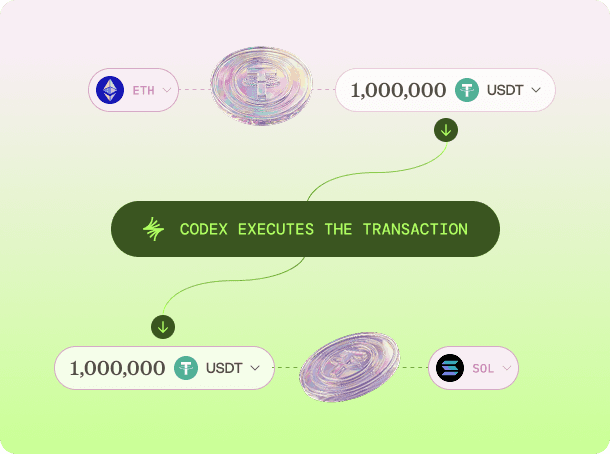
How cross-chain transfers work
Codex acts as principal on both legs. You are trading directly with us, not routing through a protocol or an exchange account, so there is nothing to integrate and nothing of yours sitting in a contract mid-transfer.
Confirm your route
Select the asset, source network, and destination network in our interface. You get a live, firm quote before anything moves.
 USDT
USDT
1 USDT ↔ 1 USDT
This quote expires in 11 seconds
Send and receive
Send the asset on your source chain to the address we provide. We pay out the equivalent on the destination network, typically under 30 minutes.
1,000,000USDT
Settle on one invoice
Your bridging fee is quoted upfront and billed separately. Network costs are passed through at cost, never marked up.
1,000,000
USDCReceive
1,000,000
USDT
Supported assets and networks
Corridors vary by asset. Confirm your specific route with our team.
Book demoAssets
 USDTUSD Tether
 PYUSDPayPal USD
 USDCUSD Coin
Networks
Ethereum · Tron · Solana · Polygon · Codex · Base · Optimism · Arbitrum · Avalanche
EthereumETHTronTRX SolanaSOL
 PolygonPOL
 CodexCODEX
 BaseBASE
 OptimismOP
 ArbitrumARB
 AvalancheAVAX
Codex vs. alternatives
Three ways to move stablecoins across chains. Only one gives you a firm price and a real counterparty.


Decentralized bridge
Centralized exchanges
Counterparty and custody
Liquidity
Settlement
Execution certainty
Integration
Who it's built for
- PSPs
- Fintechs
- Neobanks
- Remittance companies
- OTC desks
- Treasury teams
For any team whose counterparties live on a different chain: move USDT, USDC, and PYUSD between networks at full value, with a firm price and no contract risk.
FAQ
Find answers about how bridging works, pricing, supported chains, and more.
A way to move stablecoins between networks with Codex as your counterparty. You send on one chain, and we pay you out on another from inventory we already hold there. No bridge protocol or exchange account sits in the middle.
A decentralized bridge locks your assets in a smart contract and moves them through shared liquidity pools, so you carry contract risk and price impact that grows with size. With Codex, you trade directly with our desk. We quote a firm price before you send, take the asset on your source chain, and pay you the same amount from our own inventory on the destination chain.
Firms that move stablecoin liquidity as part of normal operations: trading desks and market makers, treasury teams managing multi-chain inventory, PSPs and wallets funding payouts, and protocols moving between ecosystems.
Yes. Codex is built for institutional size, not retail. Because we settle from our own inventory, a seven-figure transfer gets the same firm quote and settlement window as a smaller one, with no slippage as size grows.
We support USDT, USDC, and PYUSD across Ethereum, Tron, Solana, Polygon, Codex, Base, Optimism, Arbitrum, and Avalanche. Corridors vary by asset. Confirm your specific route with our team.
Most complete in under 30 minutes. Because we pay out from inventory already on the destination network, you aren't waiting on a bridge to rebalance before your funds land.
Book a demo and we will map your assets, chains, and typical size to a firm quote and settlement window.