Codex Par: The Complete Guide to 1:1 USDT and USDC Swaps
October 6, 2026
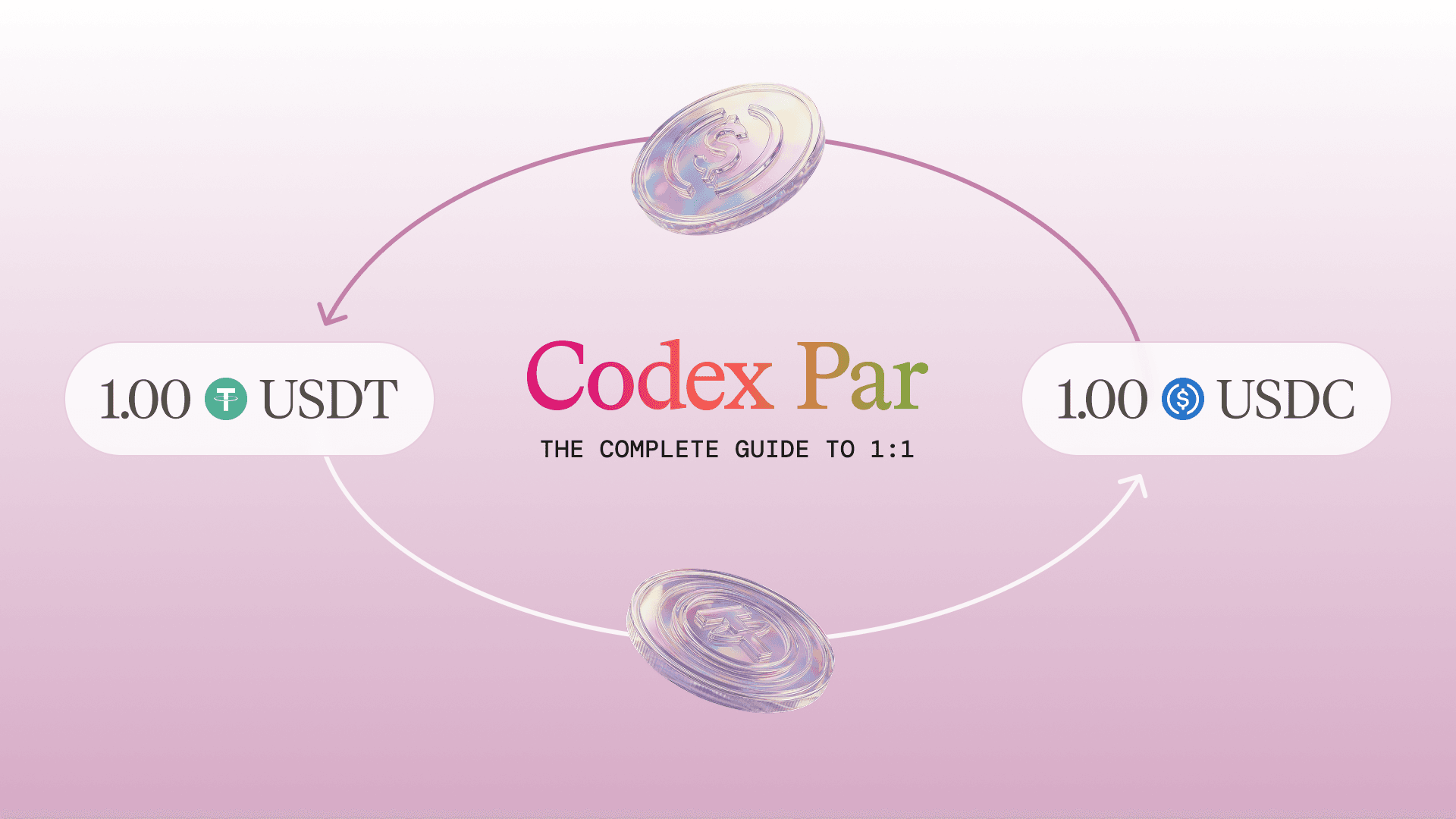
If your customers hold both USDT and USDC, they will ask to move between them. A customer who swaps 1,000 USDT expects 1,000 USDC back. On the open market, the two coins trade at a spread that changes with every trade, so the customer rarely receives the full 1,000. Codex Par closes that gap and returns exactly 1:1 in both directions.
This guide explains how Par works, what it costs, and how it compares with the alternatives.
What Is Codex Par?
Codex Par is a 1:1 stablecoin swap API for payment operators. It lets you offer your customers conversion between USDT and USDC at par, while Codex manages the liquidity and settlement behind your product. Instead of holding inventory or absorbing the spread yourself, you pay Codex a transparent fee, priced on volume tiers. Par is also available through the Codex dashboard, so your team can execute swaps without an integration.
Par is built for payment companies whose customers move between the two coins, such as PSPs, remittance companies, and neobanks. Treasury teams can also use it to rebalance their own holdings. Par has been live in production since early 2026 and now clears hundreds of millions of dollars in swap volume each month. Codex announced it publicly in July 2026. It is part of Codex FX, which moves more than $1 billion a month.
Why Payment Companies Need 1:1 Swaps
USDT and USDC hold more than $250 billion in combined circulation, but they do not trade as the same dollar. They are separate instruments from separate issuers, and the market prices them against each other at a spread. In calm markets the spread is a few basis points. Under stress it widens sharply: in March 2023, USDC traded below 90 cents while USDT held near a dollar.
Most payment companies need both coins. USDT carries most stablecoin payment flow across Latin America, Africa, and Southeast Asia. Banks, custodians, and regulated venues in the US and Europe increasingly settle in USDC. A remittance company may collect in USDT and pay out through partners that settle in USDC.
Your customers do not see any of this, and a swap that returns less than 1:1 looks like your mistake. Delivering 1:1 yourself means sourcing both coins and carrying the price risk between them on every transaction. At payment volume, you end up running an FX desk alongside your actual product.
How a Codex Par Swap Works
1. Request the swap. Your product calls the Par endpoint with the two coins and the amount. Every rate it returns is 1:1, regardless of size.
2. Codex executes it. Par executes each swap within a defined settlement window, 24/7/365. Your customer receives the full amount: 1,000,000 USDT becomes 1,000,000 USDC.
3. Get billed separately. Your fee arrives on its own invoice, priced on volume tiers. The swap your customer sees stays at exactly 1:1.
Codex holds the liquidity on both sides throughout. You keep the customer relationship and the economics of your product.
What Codex Par Costs
Codex charges you a transparent fee for Par. It is invoiced separately and priced on volume tiers, so you know what Par costs before you route any flow through it. Your customers pay no fee, and nothing is taken from the amount they swap.
Par also needs no prefunding. Codex holds and manages the liquidity on both sides, so you never tie up capital in either coin to cover swaps.
If your customers move between USDT and USDC today, book a demo with Codex FX to see Par priced at your volume.
Codex Par vs the Alternatives
Without Par, there are two common ways to give customers 1:1. Our guide to swapping USDT and USDC at scale covers the other venues, including exchanges and OTC desks.
1. Swapping onchain. DEX pools charge a fee plus gas, and the rate varies with every trade. The pool is shared, so depth thins out under load and a large swap moves the price against you. Settlement has no guaranteed time.
2. Holding inventory in-house. Keeping balances of both coins lets you promise 1:1 yourself, but only by absorbing the spread. You lock capital in inventory and carry the price risk on your balance sheet. You also need your own risk tooling, and swaps are instant only while the inventory lasts.
With Par, the rate is exactly 1:1 on institutional liquidity sized for real volume. Swaps settle within a defined window around the clock, and your cost is a volume-tiered fee you know in advance.
Supported Chains and Tokens
Codex Par supports USDC on eight networks and USDT on four:
- USDC: Ethereum, Solana, Polygon, Codex, Base, Optimism, Arbitrum, and Avalanche
- USDT: Ethereum, Solana, Tron, and Polygon
The networks matter because each coin concentrates in different places. USDT payment flow runs largely on Tron and Ethereum, while USDC activity centers on Ethereum, Solana, and Base. To move a coin from one network to another, the Codex FX blockchain bridge handles cross-chain transfers at size.
Getting Started With Codex Par
Integration is one API key and one endpoint, with no pricing logic to maintain on your side. Teams that do not need an integration can use Par through the Codex dashboard instead.
Compliance builds on the checks you already run. Codex can rely on the KYB you have already performed on your customers. That KYB is subject to periodic sample testing, and you keep the customer relationship. Every transaction also passes onchain and offchain AML screening.
To see Par running at your volume, book a demo with Codex FX.
Frequently Asked Questions
What is Codex Par?
Codex Par is a 1:1 stablecoin swap API from Codex FX, also available through the Codex dashboard. Payment operators use it to offer their customers USDT and USDC conversion at par, and they pay Codex a transparent, volume-tiered fee for the service.
Is there a fee to swap USDT and USDC with Codex Par?
Yes. The operator pays Codex a transparent fee, invoiced separately and priced on volume tiers. Your customers pay no fee and always receive exactly 1:1.
Which chains does Codex Par support?
USDC on Ethereum, Solana, Polygon, Codex, Base, Optimism, Arbitrum, and Avalanche. USDT on Ethereum, Solana, Tron, and Polygon.
Do we need to prefund or re-onboard our customers?
No to both. Codex holds the liquidity on both sides, so there is nothing to prefund. Codex can also rely on the KYB you have already performed on your customers, subject to periodic sample testing.
How is Codex Par different from swapping on a DEX?
A DEX pool returns whatever rate the pool holds when your trade executes, and settlement has no guaranteed time. Codex Par returns exactly 1:1 on institutional liquidity, within a defined settlement window.
To see what par looks like at your volume, book a demo with Codex FX.

.png&w=3840&q=75)